How to Select the Right Manhole Cover Without Mistakes? 5 Parameters Every Procurement Manager Must Know!
In municipal engineering construction, manhole covers may appear simple, but they involve complex technical parameters and standard systems. If procurement managers fail to grasp the key parameters, the consequences range from failed product acceptance to potential safety hazards on urban roads. So, what are the core indicators to focus on when selecting manhole covers?
Parameter 1: Load Capacity — The First Red Line in Selection.
The load capacity of a manhole cover must match the installation location. According to national standard GB/T 23858 “Manhole Covers,” covers are divided into six load classes: A15, B125, C250, D400, E600, and F900. For municipal road networks, the load capacity of manhole covers should not be less than 400 kN (D400 class), for sidewalks not less than 250 kN (C250 class), and for green spaces not less than 125 kN (B125 class). D400 class covers withstand ≥40 tons, suitable for urban arterial roads and highways with heavy vehicle traffic. E600 class covers withstand ≥60 tons, suitable for freight stations, docks, and airport runways with ultra-high load requirements.
Parameter 2: Material Type — The Foundation of Product Performance.
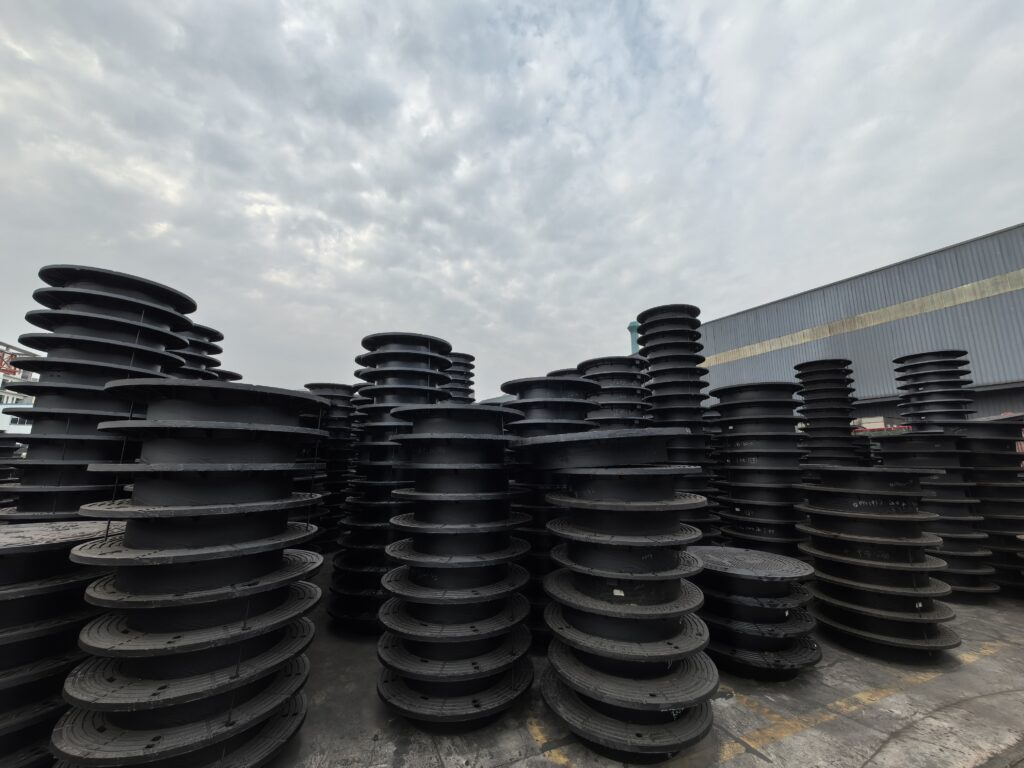
The two mainstream manhole cover materials today are ductile iron and composite materials. Ductile iron covers offer strong load-bearing capacity — D400 and above are suitable for heavy-load areas with a service life exceeding 30 years. Composite covers are lightweight (only 1/3 to 1/2 the weight of iron), naturally anti-theft, and corrosion-resistant, suitable for sidewalks and green spaces. Procurement managers must make scientific choices based on actual usage scenarios — vehicle lanes vs. sidewalks, anti-theft requirements, and corrosion resistance needs.
Parameter 3: Fit Tolerance — Key to Eliminating Jumping and Noise.
The problem of manhole cover noise and jumping often stems from excessive fit clearance between the cover and frame. The fit clearance should be controlled to ≤2 mm, with flatness deviation not exceeding 1.5 mm/m². Additionally, anti-settlement covers feature three-point spring arm locking devices that effectively secure the cover and frame to prevent jumping and reduce noise.
Parameter 4: Fall Prevention and Safety Devices — The Bottom Line for Protecting Urban “Safety Beneath the Feet.”
Safety devices such as fall prevention nets and grates are standard features of manhole covers. Particularly for manholes in low-lying and flood-prone areas, fall prevention devices should be installed to prevent accidental falls in emergency situations.
Parameter 5: Identification Information — Important Basis for Acceptance Inspection.
Upon product arrival, inspect whether the manhole cover clearly displays information including: industry identification, cover type, load class, diameter, manufacturer mark, applicable standard, and year of manufacture. The surface should be intact, smooth, uniform in material, with clear and undamaged patterns, markings, and characters, and free from defects such as cracks or porosity.