The Weight of Manhole Covers: From Engineering Parameters to LZB Metal's Lightweight Revolution
In the field of municipal infrastructure, the weight of a manhole cover is not a random design parameter but an engineering result of the comprehensive balance between load rating, material science, structural mechanics, and installation/maintenance convenience. Generally, the weight of a manhole cover depends on three core factors: size specification, load rating (such as D400, E600, F900), and material selection. Taking the most common ductile iron covers as an example, a lightweight cover (B125) with a 600mm diameter weighs approximately 30-40kg, while an ultra-heavy-duty cover (F900) with a 900mm diameter can weigh over 130kg. This seemingly simple number carries profound considerations: a commitment to the safety of workers below, the confidence to withstand vehicle loads passing above, and the careful thought given to the ease of operation for installation and maintenance personnel.
As a leading enterprise in China's manhole cover industry, the weight design of LZB Metal products reflects the outstanding results of systematic engineering optimization. Unlike ordinary manufacturers who simply increase wall thickness to enhance load-bearing capacity—a "crude approach"—LZB Metal's advantage lies in achieving the perfect unity of "lightweight and high load-bearing" through material enhancement at the source, topological optimization of structural mechanics, and precision manufacturing processes. Backed by nearly two decades of experience in manufacturing high-end municipal castings and a stringent quality control system, every LZB Metal manhole cover undergoes millions of stress simulations and extreme condition validations. Its QT500-7 ductile iron material achieves a tensile strength stably exceeding 500MPa. Combined with a three-dimensional spatial curved surface reinforcement network, products of the same load rating are 15-20% lighter than traditional designs, while their service life is extended by over 30%. This is not merely a change in weight numbers but a qualitative leap from a "cost expenditure" to a "value asset."
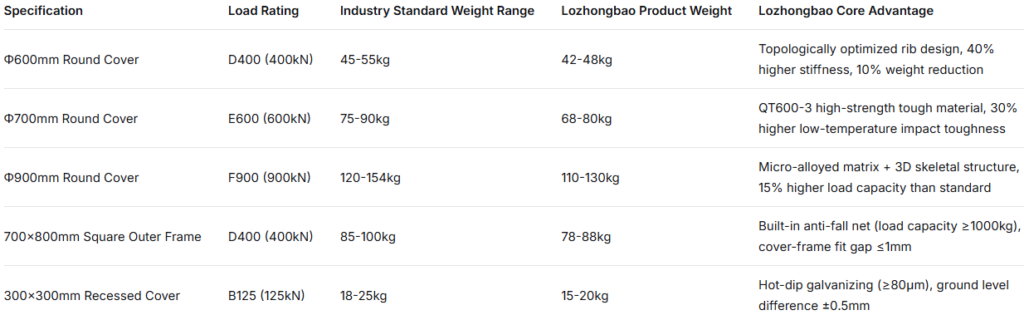
Common Manhole Cover Weight Reference and LZB Metal's Differentiating Advantages
Four Core Advantages of LZB Metal's Manhole Cover Weight Design
I. The "Strength and Toughness" Advantage of Material Source
Ordinary covers often rely solely on increasing wall thickness to meet load requirements, resulting in bulky, heavy products. LZB Metal starts from the material source, using high-grade ductile iron (QT500-7 or higher) . Through the selection of high-purity raw materials and a unique rare earth magnesium alloy spheroidizing treatment, the material achieves a tensile strength stably exceeding 500 MPa, with elongation far surpassing national standard requirements. This material characteristic, combining "high strength with high toughness," allows the cover to absorb energy through micro-deformation when subjected to heavy loads, thus preventing brittle fracture. For the same load rating, LZB Metal products can reduce wall thickness by 10-15%, correspondingly lowering weight while actually improving safety performance.
II. The "Topological Optimization" Advantage of Structural Mechanics
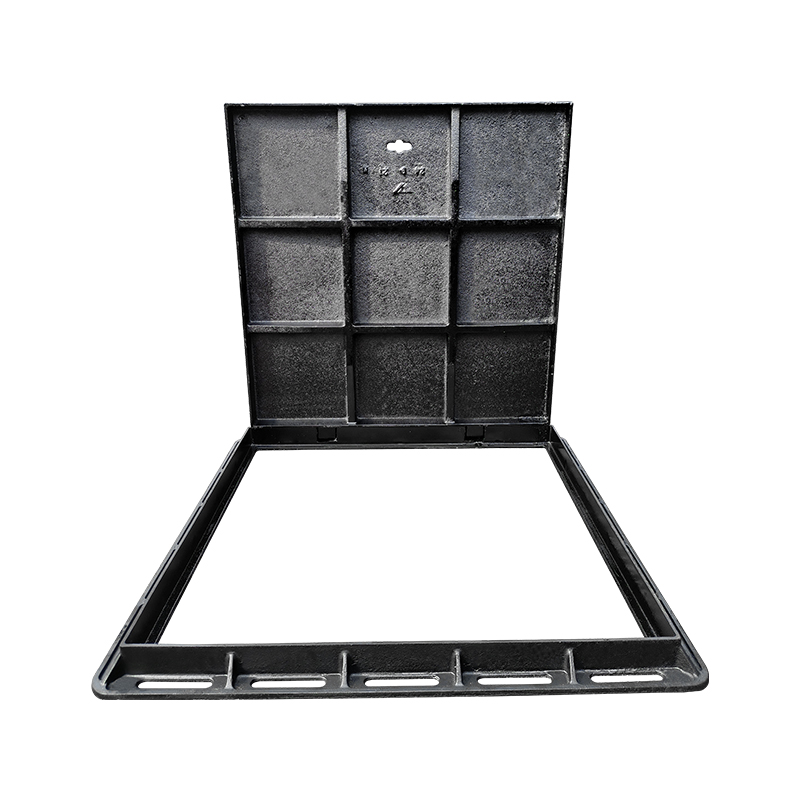
LZB Metal has abandoned traditional uniformly distributed rib patterns, introducing finite element topology optimization technology to iteratively refine the reinforcement rib layout of the cover. The resulting innovative three-dimensional spatial curved surface reinforcement network automatically "grows" dense, robust support structures in critical stress areas, while optimizing material distribution in low-stress zones to reduce weight, achieving maximum mechanical efficiency. Testing confirms that this optimized design increases the overall stiffness of the cover by over 40% compared to traditional uniform rib designs, ensuring no plastic deformation occurs under long-term heavy loads, while weight is reduced by 15-20% compared to traditional designs.
III. The "Long-lasting Protection" Advantage of the Anti-Corrosion System
The long-term durability of a cover depends not only on its inherent strength but also on the effectiveness of its anti-corrosion system. LZB Metal has constructed a triple-layer anti-corrosion protection system: a base layer of hot-dip galvanizing (zinc thickness ≥80μm) providing cathodic protection, an intermediate epoxy resin coating forming a dense barrier, and a polyurethane topcoat enhancing weather resistance. This entire system passes over 3,000 hours of salt spray testing, ensuring the main structure remains free from corrosion for 30 years in harsh environments. This long-lasting protection means that even with slightly thinner walls and lighter weight, the effective service life of LZB Metal covers far exceeds ordinary products—from a life-cycle perspective, weight is no longer a simple indicator of "thickness" but a comprehensive expression of "durability."
IV. The "Consistency" Advantage of Precision Manufacturing
LZB Metal employs intelligent static pressure casting production lines and internationally advanced equipment such as the German Eirich sand mixer. Through precise control of the solidification process using thermal field simulation, it ensures a dense, defect-free internal structure for large castings, eliminating hidden dangers such as shrinkage cavities and porosity. Data from furnace analysis, nodularity testing, heat treatment curves, and coating records for each batch of products can be traced, achieving "consistent excellence across every product". This "military-grade" quality control capability ensures precise weight control and extreme performance stability—for the same 120kg F900 cover, LZB Metal's product has a load-bearing capacity more than 15% higher than ordinary products.
Conclusion: The Engineering Philosophy Behind Weight
The weight of a manhole cover has never been an isolated number. It is an engineering expression resulting from the combined effects of material science, structural mechanics, manufacturing processes, and application scenarios. Through systematic technological innovation, LZB Metal has successfully resolved the seemingly contradictory technical challenge of balancing "lightweight" with "high load-bearing," upgrading the manhole cover from a mere "heavy component" to an "intelligent, lightweight, durable asset." For municipal managers, choosing LZB Metal means selecting not just a product that meets standard weight parameters, but a complete engineering solution, validated under extreme conditions, centered on optimizing life-cycle value.